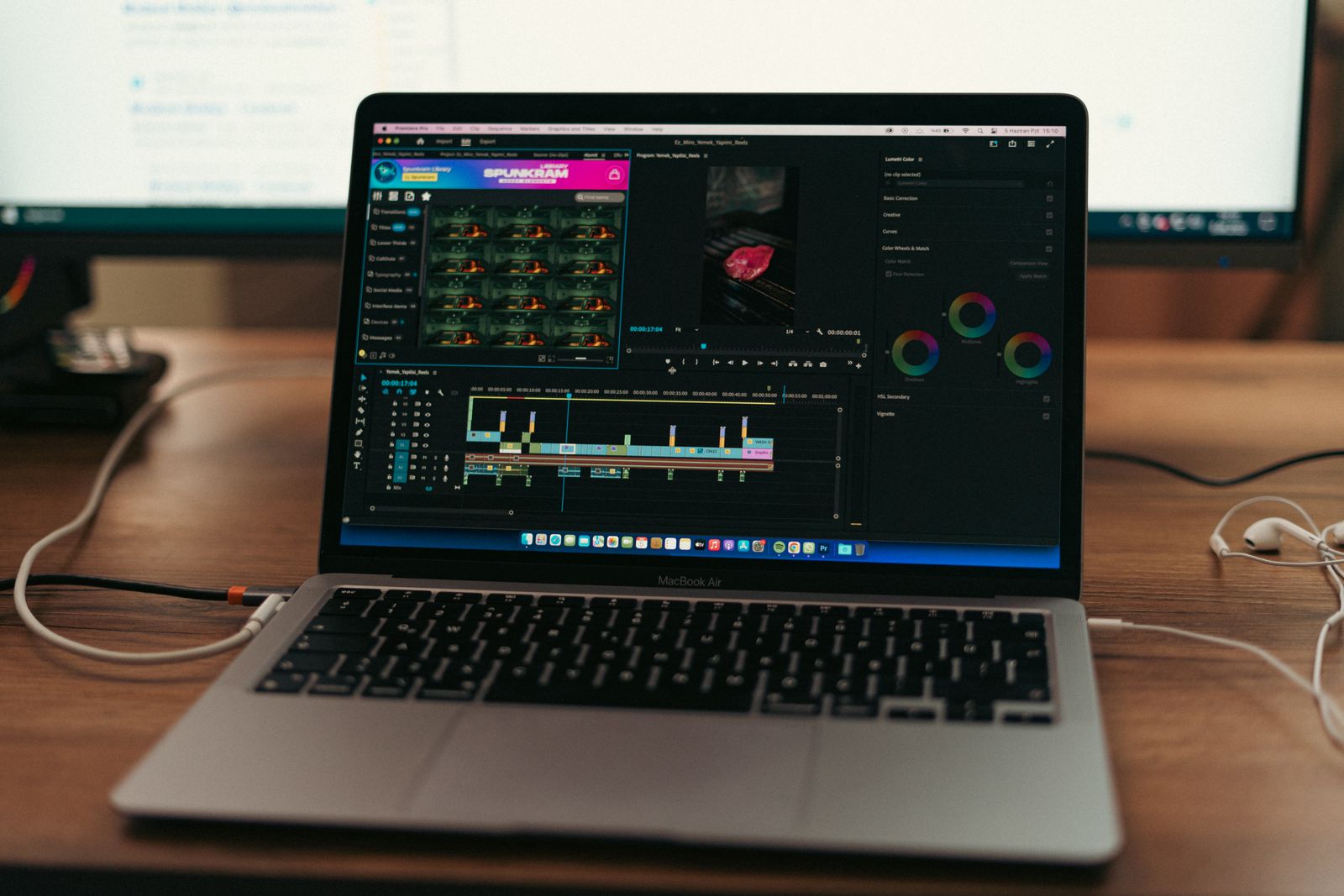
A laptop screen is small compared with the desk monitors most offices use, and a lot of work is easier with two screens: a document on one and the source on the other, a call on one and notes on the other, a spreadsheet that no longer needs scrolling sideways. At home or in the office, a desk monitor solves it. On the move, in a hotel room, a client's meeting room or a shared desk, there are two other ways to get a second screen: a portable monitor, which is a thin screen that travels in a laptop bag, and a screen extender, which clips to the laptop's lid. This guide explains both, how they connect and draw power, and what to think about before carrying one.
Why a second screen helps
Much of the time spent on a laptop is spent switching between windows. A second screen lets you keep two things in view at once and drag between them, which makes some jobs much quicker:
- Writing from a source, such as a report from notes, an email from a spreadsheet, or a quote from a supplier's price list.
- A video call on one screen and the document being discussed on the other, so you can follow along without hiding the people.
- Spreadsheets, timelines and long documents, which simply need more room.
- Photo and video editing, with the picture large on one screen and the tools on the other.
- Presenting or showing a customer something, with the screen turned towards them while you keep your own in front of you.
A second screen and your posture
There is a comfort side too. The HSE's guidance on display screen work suggests the top of the screen should be level with your eyes and about an arm's length away, and for laptops used for long periods it suggests a keyboard and mouse separate from the laptop, so the screen can be raised, and a display screen separate from the laptop. A laptop flat on a table puts its screen well below eye level. A portable monitor on its own stand, or a laptop on a stand beside a portable monitor, can bring at least one screen nearer the height the guidance describes. The guide to setting up a laptop desk goes through it all.
Where a desk monitor is better
If the laptop lives on one desk most of the week, a full-size desk monitor is larger, brighter and more comfortable than anything you can carry. The guide to connecting a laptop to a monitor or TV explains how. Portable monitors and extenders are for when the second screen has to come with you.
Portable monitors
Portable monitors are thin, light screens, usually about the same size as a laptop's own, that stand on a fold-out stand or a folding cover. Most have no power supply of their own and draw power from the laptop or a charger through a USB-C cable.
Sizes
Screen size is measured from corner to corner, across the diagonal. Portable monitors come in sizes close to laptop screens, from small ones that match a 13-inch laptop up to larger ones nearer 17 inches. Matching the size of your laptop's screen makes moving windows between them feel natural, because text and windows appear at a similar size on both. A screen much larger than the laptop is better for spreadsheets and editing but heavier to carry. Apple notes that some laptop screens with rounded corners are quoted as if they were a full rectangle, so the visible area is slightly smaller than the number: a reminder that the size on a box is a guide, not a precise measure of what you see.
Resolution and sharpness
Most portable monitors are Full HD, which is 1920 by 1080 pixels, and some are sharper. On a screen of laptop size, Full HD gives clear text for everyday work. A sharper screen looks crisper, especially beside a high-resolution laptop screen, but uses more power and needs a laptop and connection that can send it.
Matte or glossy, and brightness
A matte screen scatters reflections from windows and lights; a glossy one looks richer but reflects more. For use in offices, trains and hotel rooms, matte is usually easier to live with. Brightness matters in daylight: a dim screen beside a bright laptop screen is tiring. Check the brightness the maker gives, and remember that many portable monitors run brighter when they have their own power supply plugged in.
Stands and covers
Some portable monitors have a kickstand on the back, which can be set to several angles and is steady on a table. Others use a folding magnetic cover, which protects the screen in a bag and folds into a stand, but usually allows fewer angles. Check whether the monitor can stand upright in portrait, which suits documents and code, and whether it has a thread for a small stand or arm.
Refresh rate
The refresh rate is how many times a second the screen redraws its picture. Most portable monitors refresh at the usual rate for office screens, which is plenty for documents, email and video. Some made for games refresh faster, which makes movement look smoother, but only if the laptop and the connection can send a picture that fast. For work, it is not worth paying extra for.
Text size on two screens
A small screen with a sharp picture can make text look tiny. Both Windows and Mac let you set how large things appear on each screen separately. On Windows the setting is called Scale, in Settings, then System, then Display, with each screen chosen in turn. On a Mac it is in System Settings, then Displays, where each screen offers a choice of sizes. Setting the two screens so text looks about the same size on both makes moving between them much more comfortable.
Touch screens and speakers
Some portable monitors are touch screens. Touch works through the USB-C cable on many laptops, but check the product page for your system. Small built-in speakers are handy for a film but are no substitute for headphones or proper USB speakers.
Screen extenders that clip to the lid
Laptop screen extenders are one or two thin screens in a frame that fixes to the back of the laptop's lid. The screens slide or swing out to the side of the laptop's own screen, so you get two or three screens in a row with no stand to set up. When you are done they fold back behind the lid.
What they are good at
Extenders are quick to set up and take up no extra table space, which suits small desks, trains, hotel desks and anyone who moves between places several times a day. With two side screens, a laptop becomes a three-screen workstation, and a side screen can usually be turned round to face someone across the table.
Fit and weight
An extender adds weight to the lid, and a laptop's hinge is designed to hold up only the laptop's own screen. Check that the extender lists your laptop's screen size in its range, and look at how it grips: brackets that hook over the edges of the lid, adhesive plates, or both. A light, thin laptop with a lid that wobbles may not hold an extender steadily, and the extra weight can tip a laptop backwards on a lap. Extenders are best on a table.
The side screens are usually a little smaller than the laptop's own and sit at the same height, so they share its low position. If you use one for long periods, a stand under the laptop raises all the screens together.
Carrying them
Some extenders stay on the laptop and go into the bag with it, which makes the laptop much thicker. Others come off in a moment. Check that the laptop and extender together still fit your sleeve or bag, and measure the combined thickness if you can.
Connecting and powering them
This is where most problems with second screens begin, so it is worth understanding before you buy.
USB-C with video
The neatest way to connect a portable monitor is one USB-C cable that carries the picture, power and sometimes touch, all at once. That relies on a standard called DisplayPort Alt Mode, set by VESA, the body behind DisplayPort, which lets a USB-C port send a DisplayPort picture. Not every USB-C port can do this. Some are for charging and data only. VESA's DisplayPort site says a port that supports it will normally have the DisplayPort logo near the connector, and that the laptop's own documentation should say. Thunderbolt and USB4 ports carry video as well. If there is no logo, check the specifications page for your exact laptop, which lists what each port can do.
The cable
Two USB-C cables can look the same and do different jobs. VESA says the picture, USB data and USB Power Delivery can all be carried at once by a standard full-featured USB-C cable. A cable sold only for charging may carry power but not a picture, which is a common reason a monitor powers on but stays blank. Use the cable that came with the monitor, or a USB-C to USB-C cable described as supporting video. The guide to USB-C explains the names and logos on cables.
HDMI
Most portable monitors also have a small HDMI socket, often mini HDMI. That is useful for laptops without video over USB-C, and for games consoles and cameras. With HDMI, the picture comes over the HDMI cable and the power has to come separately, through the monitor's USB-C socket from a charger or a spare USB port. Check which HDMI plug the monitor uses and whether a cable comes with it; HDMI cables and USB-C to HDMI cables cover the common joins.
Power
A portable monitor powered from the laptop takes its power from the laptop's battery. How much power a laptop's USB-C port can give out varies from one laptop to another, and a bright screen may need more than some ports supply. Signs of too little power are a monitor that flickers, dims or turns off, especially at full brightness. The answer is to give the monitor its own power: most have a second USB-C socket for a charger. On some, power from a charger plugged into the monitor is passed on to the laptop too, so one charger runs both. USB Power Delivery, the standard that lets a USB-C charger and laptop agree on power, goes up to 100 watts on ordinary cables and to 240 watts on cables made for it, according to the USB Implementers Forum. A USB-C laptop charger with enough watts for the laptop and the screen together is the simplest arrangement on a desk. Add up what the laptop's own charger is rated at and what the monitor's maker says it needs, and choose a charger at least that large.
Extenders and USB connections
Screen extenders connect the same ways, by USB-C with video or HDMI. Some extenders and monitors instead send the picture over an ordinary USB data connection, using a small graphics chip inside the screen. These work on ports that cannot send video directly, but need the maker's software installed on the laptop, and moving pictures may not be as smooth. The product page says which kind it is.
How many screens your laptop can drive
Every laptop has a limit on how many external screens it can run, whatever you plug in. Apple gives the figures for MacBooks on its support pages. The MacBook Air with M2 supports one external display. The MacBook Air with M3 supports two external displays only with the lid closed, with an external keyboard and mouse or trackpad and macOS Sonoma 14.3 or later. The MacBook Air with M4 supports up to two external displays alongside its own screen, and Apple says closing its lid does not add another. For other laptops, the specifications page for your model gives the limit. A screen extender with two side screens counts as two external screens.
Setting it up
On Windows, press the Windows logo key and P together and choose Extend, which makes the second screen part of one wide desktop. Microsoft's own first check when a second monitor does not work is that Extend is selected. To arrange the screens, open Settings, then System, then Display, and drag the screen pictures so they match where the screens sit on your desk. On a Mac, open System Settings, then Displays. Choose whether the screen extends or mirrors your desktop, and use Arrange to drag the screens into position. If the Mac does not see a screen you have just connected, Apple says to hold the Option key so that Detect Displays appears, and click it.
A USB-C hub or a docking station can connect a monitor too, but the laptop's limit still applies, and a hub can only pass on video if the laptop's port can send it. The guide to USB-C hubs and docks goes into the detail.
Sizes, weight and carrying
A second screen that stays at home because it is too heavy to carry is no use on the road, so think about the journey as well as the desk.
Weight
A portable monitor adds roughly the weight of another thin laptop's screen to your bag, and an extender with two screens adds more. The maker's weight is on the product page. If you carry a laptop every day on foot or on public transport, a smaller, lighter screen you take with you beats a larger one you leave behind.
Protecting the screen
A portable monitor's screen has no lid to protect it. A folding cover helps, but pressure in a crowded bag can still crack the glass. A padded sleeve sized for the monitor, or a bag with a second padded compartment, keeps it safe. Carry the monitor screen-in, against the laptop's lid or a padded wall, not against a water bottle or charger.
Using one on the move
On a train table or a hotel desk, space is the limit. A portable monitor on a kickstand needs room behind it, so a narrower monitor standing beside the laptop often fits where a wide one does not. Turning it to portrait can help on a narrow table. In a café or on a train, remember that a second screen is a second thing for people nearby to read; the guide to privacy filters and protection explains how filters work. Before you leave, check the table for the cable as well as the screen: the short cable is the part people most often leave behind.
Cables and chargers
Keep the monitor's cables together in a tech pouch, so the right cable is always with the screen. A short USB-C cable is tidier on a table than the long one most monitors come with.
Breaks
Two screens make it easy to work longer without moving. The HSE advises short breaks often rather than longer ones less often, giving the example that 5 to 10 minutes every hour is better than 20 minutes every two hours, and suggests using breaks to get up, move and change posture.
Questions people ask
Why does my portable monitor turn on but show no picture?
Usually the laptop's USB-C port cannot send video, or the cable carries only charging. Try the cable that came with the monitor, another USB-C port on the laptop, or HDMI with separate power.
Can a portable monitor run from my laptop's battery?
Yes, through one USB-C cable, if the laptop's port gives enough power. It will run the laptop's battery down faster. If the screen flickers or dims, plug a charger into the monitor.
Will a screen extender fit my laptop?
Check the range of screen sizes the extender lists, and whether its brackets suit a thin lid. A lid that wobbles may not hold the extra weight steadily.
How many extra screens can I add?
That depends on your laptop, not the screen. Apple lists the number for each MacBook, and the specifications page for other laptops gives it. A two-screen extender counts as two.
Do portable monitors work with phones and consoles?
Many do, through USB-C with video or HDMI. Check that the device can send a picture that way.
Where to go next
Second screens are in portable monitors and laptop screen extenders, with the travellers and creators ranges gathering what goes with them. For the other parts of the job:
- USB-C explained: ports, cables, power and video
- How to connect a laptop to a monitor or TV: desk monitors and televisions
- How to choose a USB-C hub or docking station: one cable for everything
- Setting up a laptop desk that is kind to your back: where the screens should sit


