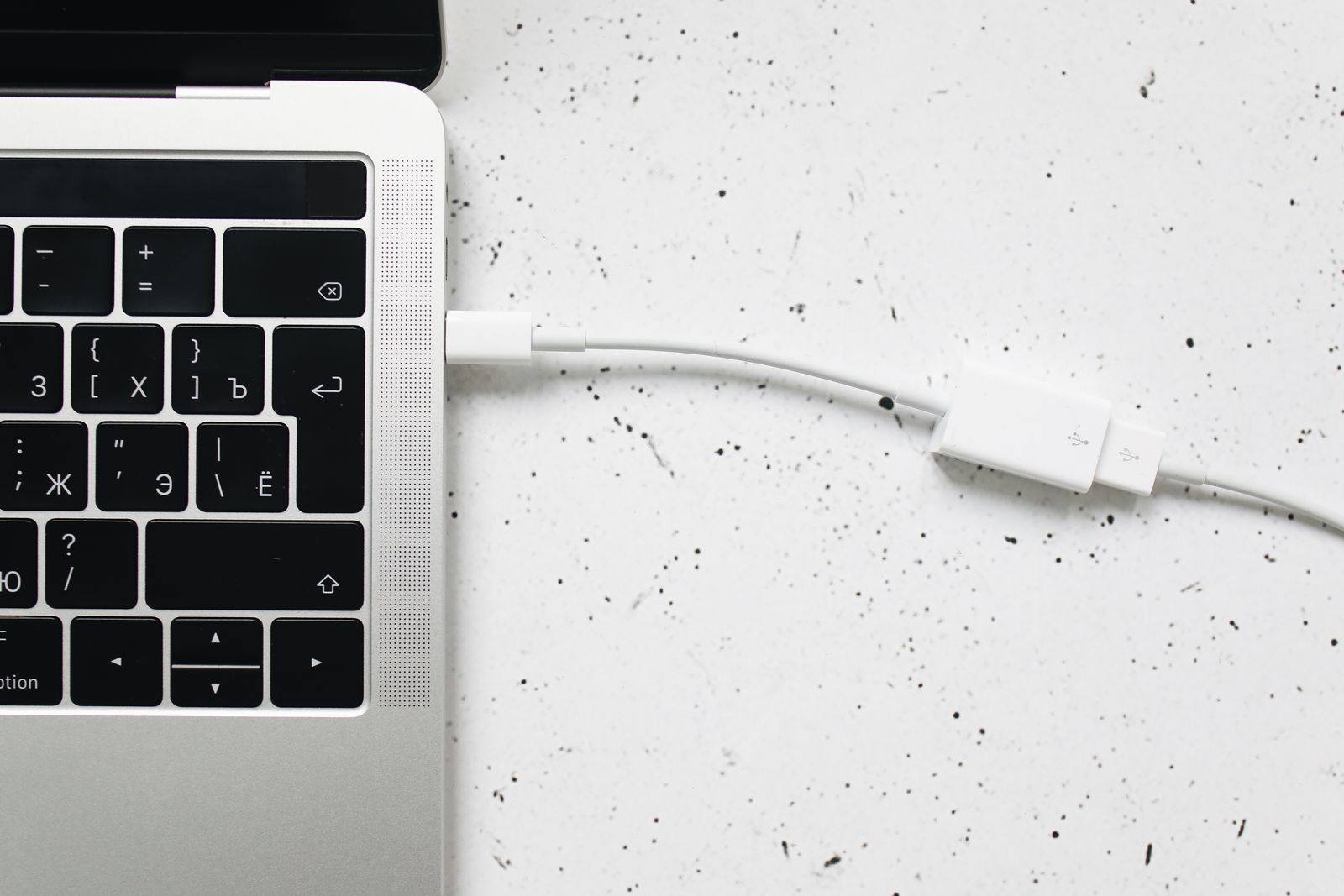
A laptop charger looks like the dullest part of the kit, until it is lost, left at the office or starts to run hot. Replacing one raises questions that are easy to answer once you know what the numbers mean. How many watts do you need? Will a phone charger do? Is a bigger charger safe? What about older laptops with a round plug? And why does it matter so much that a charger has a proper UK plug? This guide covers each of those in turn, using the official guidance from the people who make the standards and laptops and from the UK's product safety regulator.
What the watts mean
Every charger has a small block of print on it, usually on the underside or one end. The line marked "Output" tells you what it supplies, in volts (V) and amps (A), and often in watts (W). Watts are simply volts multiplied by amps: a charger supplying 20 volts at 3.25 amps gives 65 watts. Watts are the useful figure, because they tell you how much power is available to run and charge the laptop at the same time.
Finding out how many watts your laptop needs
The easiest place to look is the charger that came with the laptop: its output line or the large figure on its label is what the maker intended. If that charger is lost, the laptop's specification page or manual lists the charger it was sold with. Apple says the wattage is printed on the certification label of every Apple power adapter, and on a Mac you can see the connected charger's details by holding the Option key, choosing System Information from the Apple menu and selecting Power. For Apple's own laptops, MacBook Air models from 2022 onwards were sold with 30, 35, 67 or 70-watt adapters depending on the model. Microsoft publishes a table of the recommended wattage for each Surface, and many of its models list 45 or 60 watts.
As a rough guide to sizes, small laptops, Chromebooks and tablets often need around 45 watts, everyday laptops around 65 watts, and larger laptops 100 watts or more. Your own laptop's figure is the one to go by. The USB-C laptop chargers are grouped by power for that reason: 45W, 65W, 100W and 140W.
More watts or fewer
For a laptop that charges through USB-C, a charger with more watts than it needs is fine. The laptop only takes the power it asks for, which is explained in the next section. Apple says a Mac that charges over USB-C can use any USB-C power adapter, even one with a higher or lower wattage than the one recommended.
A charger with fewer watts will usually still charge the laptop, but more slowly, and if the laptop is working hard it may barely keep up. A Mac shows "Slow Charger" in the battery menu when the power is too low for the model. Microsoft says that a Surface on a charger below the recommended wattage may charge slowly or not at all, and may run more slowly while in use. So a smaller charger is a reasonable spare for the bag, but not the best everyday charger for a powerful laptop.
Chargers with several sockets
Many chargers have two or three sockets so that the laptop and a phone can charge together. The figure on the box is usually the total, shared between the sockets. When a phone is plugged in alongside the laptop, the laptop's socket may give less than the full figure. The description of a good multi-socket charger lists what each socket gives on its own and together, so check that the laptop's socket still gives enough with everything plugged in.
Laptops that need more than USB-C gives
Many gaming laptops and powerful workstations need more power than most USB-C chargers supply, and come with a large charger and a round or rectangular plug of their own. Some of them can top up slowly from USB-C, but they need their own charger to run at full power.
USB-C charging and how a charger and laptop agree
Laptops that charge through USB-C use a system called USB Power Delivery, or USB PD. It is set by the USB Implementers Forum (USB-IF), the body that looks after the USB standards, and it is the reason one charger can safely charge a laptop, a tablet and a phone.
The conversation before the power
When a USB PD charger is plugged into a laptop, the two talk to each other before anything much happens. The charger starts at a low, safe voltage and tells the laptop what it can offer. The laptop asks for the level it wants, and only then does the charger step up to it. If the laptop needs less, it asks for less. The USB-IF describes this as a device negotiating for only the power it requires. It is why a big charger cannot push too much power into a small device.
The levels
Up to 2021, USB PD reached a maximum of 100 watts, made from 20 volts at 5 amps. The USB PD 3.1 update added higher voltages of 28, 36 and 48 volts, giving 140, 180 and 240 watts. The levels up to 100 watts are called the Standard Power Range and the higher ones the Extended Power Range. A laptop that needs 140 watts through USB-C needs a charger and a cable that both support the Extended Power Range.
The cable has to keep up
The cable is part of the chain. The USB-IF's labels for certified USB-C cables show either 60 watts or 240 watts. A 60-watt cable carries up to 3 amps at 20 volts, which suits laptops up to 60 watts. Above that, the cable must be built for 5 amps, and it carries a small chip that tells the charger so. A charger will not deliver more than the cable says it can carry, so a 100-watt charger with a 60-watt cable gives the laptop 60 watts. The USB-C to USB-C laptop cables are described by the watts they are rated for, and a 240-watt cable covers every level. The guide to USB-C explains the cable ratings in more detail.
Phone chargers and fast-charging systems
Many phone chargers are small USB PD chargers, often 20 or 30 watts. They will charge some laptops slowly, especially when the laptop is asleep, which is handy in an emergency. Some phone chargers use their own fast-charging systems instead of USB PD, and a laptop may only take a trickle from those. Apple's guidance is that a third-party adapter for a Mac must support USB Power Delivery. A charger described as "PD" is the one to use for a laptop.
Small chargers and GaN
Many newer chargers are described as GaN, short for gallium nitride, a material used in place of silicon in the parts that switch the power. It allows a charger of the same wattage to be much smaller and lighter, which is why a 65-watt charger can now be not much larger than an old phone charger. It is a good thing to look for when the charger lives in a bag.
Charging through a dock or monitor
Docks, hubs and some USB-C monitors pass power to the laptop down the same cable as the picture and data. Apple says a Mac that charges through USB-C can charge from a display as well as from an adapter. A hub keeps a little of the power for itself, so the laptop receives slightly less than the charger supplies. The guide to USB-C hubs and docks covers this.
Which socket
Some laptops charge from any of their USB-C sockets and some from only one or two. A small battery or plug symbol beside a socket usually marks a charging socket, and the specification page says for certain.
Round-plug laptops and universal chargers
Plenty of laptops, especially older ones and many gaming laptops, charge through a round barrel plug or a plug shape of their own rather than USB-C. For these, the charger must match the laptop much more closely, because there is no conversation between the two: the charger simply supplies its voltage.
The four things that must match
- Voltage: the output voltage must be the same as the original charger's. Look at the "Output" line on the old charger or on the laptop's label underneath.
- Power: the watts, or amps, must be at least the same as the original. More is fine; less can mean the laptop does not charge while in use.
- Plug size: barrel plugs come in many outer and inner diameters. A plug that is nearly right can make a poor contact that runs warm.
- Polarity: which part of the plug is positive. The label shows it with a small symbol of a dot inside a C, with plus and minus marks on either side. Most laptops use the centre as positive, but check yours.
Some laptops also check that the charger is one their maker approves through a signal on the centre pin of the plug, and may charge slowly or refuse to charge with another. If your laptop does this, the description of a replacement should say it is compatible with that model.
Universal chargers
Universal laptop chargers come with a set of interchangeable tips to fit different laptops. Some set the voltage automatically from the tip and some have a switch. With a switch, set the voltage to match your laptop before connecting it, every time. Keep the tip that fits your laptop on the cable and the rest in a tech pouch.
Universal chargers are also where some of the worst products turn up. The Office for Product Safety and Standards (OPSS), the UK's product safety regulator, has required the recall of a universal laptop power supply sold online because of a high risk of electric shock, caused by too little separation between the mains and low-voltage parts inside. The next section explains what to check.
In the car
Car laptop chargers run a laptop from a car's 12-volt socket. They come as USB-C chargers that work just like the mains ones, and as chargers with tips for round-plug laptops. The same rules apply: enough watts, and for round plugs the right voltage, size and polarity. The guide to charging a laptop on the move covers car chargers and laptop power banks in detail.
Why a UK three-pin plug matters
A laptop charger is plugged into the mains for hours at a time, often overnight, so the plug matters more than its size suggests.
What the law says
In the UK, the Plugs and Sockets etc. (Safety) Regulations 1994 require an electrical appliance to be correctly fitted with a standard plug: one with three rectangular pins made to fit a socket built to the British Standard BS 1363, and containing a fuse made to BS 1362. The other route the law allows is a plug from another country enclosed in an approved conversion plug, made so that it cannot be taken off and used on its own. A loose travel adapter pushed onto a two-pin plug is not the same thing.
What the fuse and pins do
The fuse in a UK plug protects the lead. If a fault makes too much current flow, the fuse breaks the circuit before the lead can overheat. The shape and size of the pins are set by the British Standard so that the plug fits the socket firmly. A plug that is the wrong size can sit loosely in the socket and make a poor contact.
What the regulator has found
OPSS publishes the results of its tests on gov.uk, and laptop chargers appear there regularly. Recent reports include a laptop-style adapter whose plug did not meet the dimensions of BS 1363, with a fuse that had not been properly packed and with required markings missing, rated a serious fire risk, and a 45-watt laptop charger whose plug pins did not meet the requirements, which was stopped at the border. Faults like these are hidden inside the plug and cannot be seen from a photograph.
What to look for
- A fixed UK three-pin plug, or a plug fitted with a proper conversion plug, rather than a two-pin plug with a loose adapter.
- The UKCA or CE mark, which the government's product safety advice says is required by UK product safety regulations.
- Information about the maker or importer and the ratings printed on the charger.
The government's "Product safety alerts, reports and recalls" pages on gov.uk can be searched for any charger you already own.
Charging safely
Laptops and their chargers are safe when they are used as intended. Most of the advice comes down to letting heat escape and noticing early when something is wrong.
Let the heat out
Laptops and chargers warm up in normal use, and both need air around them. Apple's safety information for its laptops says to keep the laptop and its power adapter in a well-ventilated place when in use or charging; not to put the laptop or adapter under a blanket, a pillow or your body while connected to power; and not to use the laptop on a pillow, a blanket or other soft material that can block the vents. It also advises avoiding long contact with the skin while it is running or charging, and plugging the adapter straight into a wall socket. The same sense applies to any laptop. A lap desk or bed tray gives the laptop a firm surface on the sofa or the bed, and the guide to keeping a laptop cool goes further.
The government's charging advice
OPSS's advice on charging is written for e-bike and e-scooter batteries, which are much larger, but its points hold for any lithium-ion battery and charger:
- only use the correct charger for the battery;
- charge when you are awake and present, not while asleep or away from home;
- do not cover the charger or the battery while it charges;
- unplug the charger when charging has finished;
- stop using a charger or battery straight away if it is overheating or changing shape.
Signs to stop
Stop using a charger that is too hot to hold comfortably, smells of burning, buzzes, or has a cracked case, a frayed or kinked lead or a loose plug. Stop using a laptop whose case is bulging, whose trackpad has lifted or whose base no longer sits flat, because these can be signs of a swollen battery. Switch it off, unplug it and have it looked at rather than pressing the case back into shape. The government's advice is that nobody should try to put out a lithium-ion battery fire themselves: leave the room or building and call 999.
Look after the lead
Most chargers that fail do so at the lead, where it meets the plug or the brick. Avoid wrapping the lead tightly round the charger, avoid sharp bends at the ends, and pull on the plug rather than the lead to disconnect. A loose coil held with a cable tie or clip is kinder to it. Travelling with a laptop brings its own rules for power banks on flights, which the guide to charging on the move covers.
Questions people ask
Can I charge my laptop with my phone charger?
If the laptop charges through USB-C and the phone charger supports USB Power Delivery, yes, but slowly. A small phone charger may not keep up while the laptop is working hard.
Is a charger with more watts than my laptop needs safe?
For USB-C charging, yes. The laptop asks for the power it needs and the charger supplies only that. For a round-plug laptop, the voltage must match exactly, and only the watts may be higher.
Why does my Mac say "Slow Charger"?
Apple shows this when the charger, or the cable, supplies too little power for that model. Use a charger of at least the recommended wattage and a cable rated for it.
Do I need a special cable for a 140W charger?
Yes. Above 100 watts, USB-C charging uses higher voltages that need a cable rated for 240 watts. A 60-watt cable limits any charger to 60 watts.
Why is it a problem if a charger has a two-pin plug and an adapter?
UK law requires a standard three-pin plug with a fuse, or an approved conversion plug fitted so it stays on. A loose travel adapter gives neither the fuse nor a secure fit.
Where to go next
All the power kit is under laptop charging and power, and by output in up to 45W and 140W and over. Delivery is included in every price and tracked to your door. For more on power and the sockets it flows through:
- USB-C explained: the sockets, cables and power levels
- Charging a laptop on the move: power banks and car chargers
- How to choose a USB-C hub or docking station: charging through a hub
- How to keep a laptop cool: heat, vents and cooling pads


